Different Types of Marriage in Nigeria | Legal Guide
Understanding the Types of Marriage in Nigeria is not merely a cultural or religious concern—it is a fundamental legal decision with lasting consequences. The form of marriage a couple contracts determines critical legal issues such as property ownership, inheritance rights, divorce procedures, child custody, succession planning, immigration documentation, and even business asset protection.
In legal practice, many disputes arise not because parties intended wrongdoing, but because they entered one form of marriage while assuming the law would treat it as another. Nigerian courts are strict on this point: the legal regime under which a marriage is contracted determines its legal effects, and parties cannot switch regimes mid-dispute for convenience.
This guide explains the Different Types of Marriage in Nigeria, their legal foundations, validity requirements, and—most importantly—the Legal Effects of Marriage in Nigeria.
How Many Types of Marriage Are There in Nigeria?
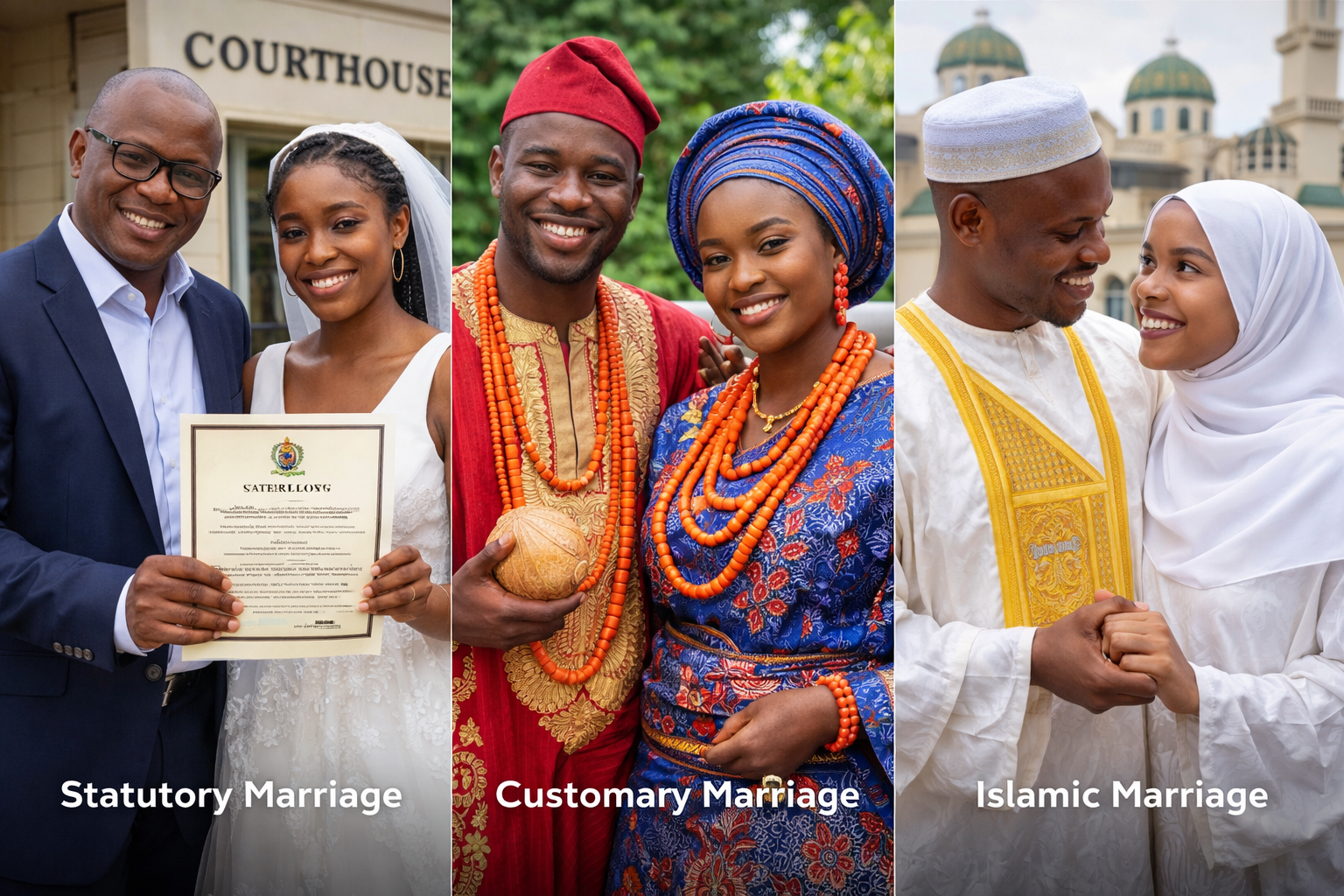
Under Nigerian law, there are three legally recognised types of marriage:
- Statutory Marriage (Marriage under the Act)
- Customary Marriage in Nigeria
- Islamic Marriage in Nigeria
Although people often refer to “church weddings,” “white weddings,” or traditional ceremonies as separate categories, they are not independent legal regimes. Their legal status depends entirely on which law governs the marriage and how it was conducted and registered.
The Legal Foundation of Marriage in Nigeria
Marriage in Nigeria operates under a plural legal system. This means that marital relationships are governed by different bodies of law, including:
- Statutory law, particularly the Marriage Act and Matrimonial Causes Act
- Customary law, based on ethnic and community customs
- Islamic law, applicable as personal law to Muslims
- Judicial precedents, interpreting and applying these laws
The applicable legal regime determines:
- Whether the marriage is monogamous or polygamous
- Which court has jurisdiction
- How divorce or dissolution is handled
- How inheritance and succession apply
- What constitutes valid proof of marriage
Overview of the Major Types of Marriage in Nigeria
For practical Nigerian legal analysis, marriage is best classified into three major categories:
- Statutory Marriage
- Customary Marriage in Nigeria
- Islamic Marriage in Nigeria
Each operates independently and produces distinct legal consequences.

1. Statutory Marriage in Nigeria (Marriage Under the Act)
What Is Statutory Marriage?
A statutory marriage is a marriage celebrated under the Marriage Act, usually at a Marriage Registry or in a licensed place of worship authorised to conduct marriages under the Act. It is strictly monogamous, meaning one man and one woman to the exclusion of all others.
Key Requirements for Statutory Marriage
While administrative procedures may vary, statutory marriage generally requires:
- Notice of intention to marry
- Proper identification and declarations
- Celebration by a registrar or authorised minister
- Registration and issuance of a marriage certificate
The marriage certificate is critical, as it serves as primary documentary proof.
Legal Effects of Statutory Marriage in Nigeria
The Legal Effects of Marriage in Nigeria under statutory marriage include:
- Strict monogamy: contracting another marriage during its subsistence may be void and expose parties to legal liability
- Clear court jurisdiction for divorce and marital disputes
- Strong evidentiary value due to official documentation
- Greater certainty in inheritance, succession, and estate planning
Important Note: Performing traditional marriage rites after a statutory marriage does not convert the marriage into a customary or polygamous union.
2. Customary Marriage in Nigeria
What Is Customary Marriage?
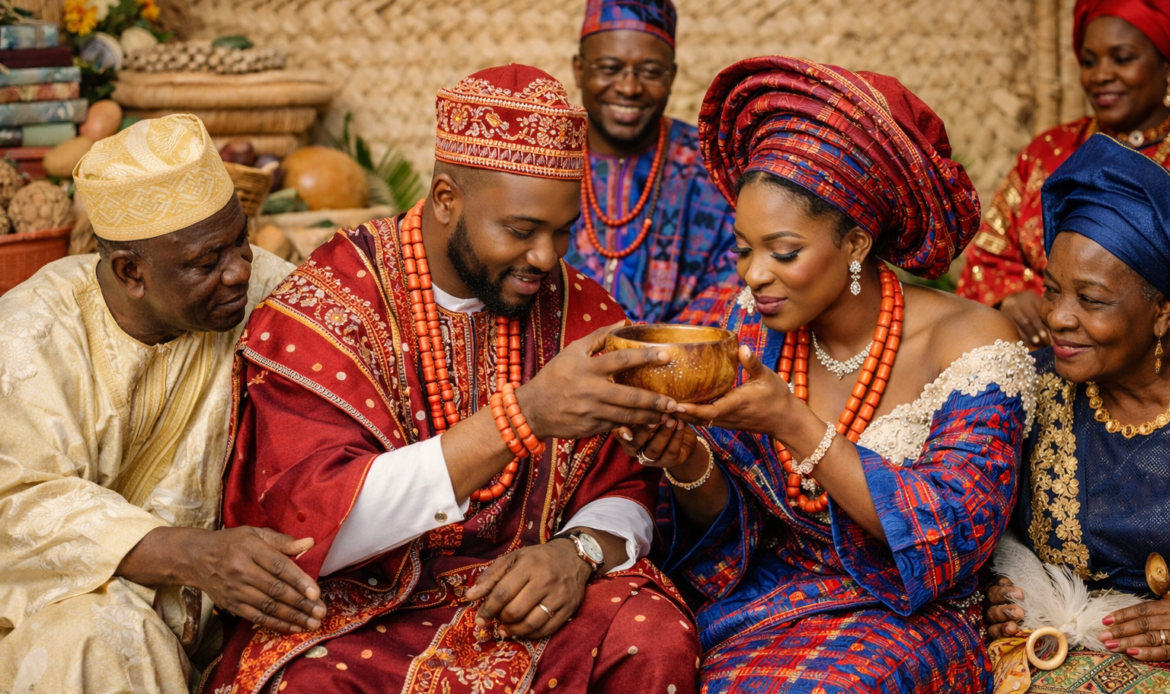
Customary Marriage in Nigeria is a marriage conducted according to the customary law of an ethnic group or community. It typically involves family consent, customary rites, and bride price or dowry elements, depending on local tradition.
Validity of Customary Marriage
The most common legal issue with customary marriage is proof. Courts usually look for evidence that:
- The marriage was conducted according to the relevant custom
- Essential customary rites were performed
- Families consented
- Witnesses can credibly testify to the ceremony
Is Customary Marriage Polygamous?
Generally, customary marriage is potentially polygamous, subject to the specific custom governing the marriage. This distinguishes it sharply from statutory marriage.
Legal Effects of Customary Marriage in Nigeria
The Legal Effects of Marriage in Nigeria under customary law often affect:
- Inheritance and succession, frequently shaped by local custom
- Divorce procedures, which differ from statutory divorce
- Property rights, often assessed based on contribution, documentation, and fairness
Modern courts increasingly scrutinise discriminatory customary practices, especially where constitutional rights are implicated, though outcomes depend on specific facts and jurisdiction.
3. Islamic Marriage in Nigeria
What Is Islamic Marriage in Nigeria?
Islamic Marriage in Nigeria (Nikah) is a marriage contracted under Islamic law between Muslims. It is recognised as a valid form of marriage under Nigerian law where Islamic personal law applies.
Key requirements typically include:
- Offer and acceptance (ijab and qabul)
- Witnesses
- Dowry (mahr), as required by Islamic principles
Is Islamic Marriage Monogamous or Polygamous?
Islamic marriage is generally potentially polygamous, subject to Islamic legal rules and fairness obligations imposed on the husband.
Legal Effects of Islamic Marriage in Nigeria
The legal effects include:
- Distinct rules on maintenance, divorce, inheritance, and custody
- Proof often relies on witnesses, documentation from religious authorities, and consistent evidence of the marital relationship
Can the Types of Marriage in Nigeria Be Combined?
This is one of the most misunderstood aspects of Nigerian marriage law.
Where a Statutory Marriage Exists
A person cannot validly contract a customary or Islamic marriage during the subsistence of a statutory marriage.
Where a Customary or Islamic Marriage Exists
Parties may later contract a statutory marriage. However, once a statutory marriage is properly celebrated, it converts the union into a monogamous marriage under the Act going forward.
LEGAL TIP
In Nigeria, the type of marriage you contract—statutory, customary, or Islamic—determines your legal rights and obligations. A marriage under the Marriage Act is strictly monogamous, while customary and Islamic marriages may permit polygamy. Mixing marriage types without proper legal guidance can affect inheritance, property rights, and divorce proceedings. Always confirm the legal regime governing your marriage and ensure proper documentation to avoid future disputes.
Legal Effects of Marriage in Nigeria on Property and Business Assets
For professionals, entrepreneurs, and investors, the type of marriage contracted can affect:
- Ownership of landed property
- Succession and probate outcomes
- Business shares and income
- Asset tracing in marital disputes
- Documentation for immigration and international processes
Understanding the Types of Marriage in Nigeria is therefore an essential risk-management strategy.
Common Mistakes Nigerians Make
- Assuming cohabitation equals marriage
- Assuming a church or white wedding automatically creates statutory marriage
- Failing to secure proof of marriage
- Late or non-registration of marriages
- Mixing marriage regimes without legal advice
These mistakes often surface during inheritance disputes, divorce, or property conflicts
Frequently Asked Questions
Under Nigerian law, there are three legally recognised types of marriage:
- Statutory Marriage (Marriage under the Marriage Act)
This is a monogamous marriage conducted at a marriage registry or a licensed place of worship and governed by statutory law. - Customary Marriage in Nigeria
This is a marriage conducted according to the customs and traditions of an ethnic community and governed by customary law. It is generally potentially polygamous. - Islamic Marriage in Nigeria
This is a marriage conducted under Islamic law (Nikah) between Muslims and governed by Islamic personal law. It is also potentially polygamous, subject to Islamic rules.
Any other description (such as “church marriage” or “white wedding”) is not a separate legal category unless it complies with one of the three regimes above
From a strict legal perspective in Nigeria, there are not eight legally recognised types of marriage.
However, in sociological, religious, or academic discussions, people sometimes list various forms of marriage such as:
- Monogamous marriage
- Polygamous marriage
- Customary marriage
- Islamic marriage
- Statutory marriage
- Church marriage
- Traditional marriage
- Civil marriage
Legally, these descriptions collapse into the three recognised regimes under Nigerian law:
- Statutory
- Customary
- Islamic
Therefore, while people may informally refer to “8 types of marriage,” only three have legal recognition and enforceable legal consequences in Nigeria.
Legally speaking, there are three valid ways of contracting a marriage in Nigeria, corresponding to the three legal regimes:
- Marriage under the Marriage Act
- Marriage under Customary Law
- Marriage under Islamic Law
Any other “way” of marriage is only legally valid if it falls squarely within one of these three frameworks and satisfies its requirements.
The seven stages of marriage are not a legal concept under Nigerian law. They are commonly referenced in religious, counselling, or social psychology contexts, not legal practice.
From a legal standpoint in Nigeria, the law is concerned only with:
- Capacity to marry
- Validity of the marriage ceremony
- Applicable legal regime
- Proof of marriage
- Legal effects of the marriage
Stages such as courtship, engagement, early marriage challenges, or marital growth phases have no legal status unless they relate to the formal requirements for contracting or dissolving a marriage.
Professional Clarification
For legal purposes—especially in matters of property, inheritance, divorce, custody, and succession—what matters is not the stage or description of marriage, but the type of marriage recognized by law and the evidence supporting it.
Understanding this distinction prevents costly disputes and legal uncertainty.
Conclusion
The Different Types of Marriage in Nigeria are not interchangeable labels; they are distinct legal regimes with far-reaching consequences. The safest approach is to choose deliberately, document properly, and understand the Legal Effects of Marriage in Nigeria before disputes arise.
For anyone with property, children, business interests, or international plans, clarity on Customary Marriage, Customary Marriage in Nigeria, and Islamic Marriage in Nigeria is not optional—it is essential legal planning.
Know your marriage type, protect your rights, and avoid future disputes—get legal guidance today.
For clarity on marriage types and their legal effects, consult Chaman Law Firm for trusted advice.
