

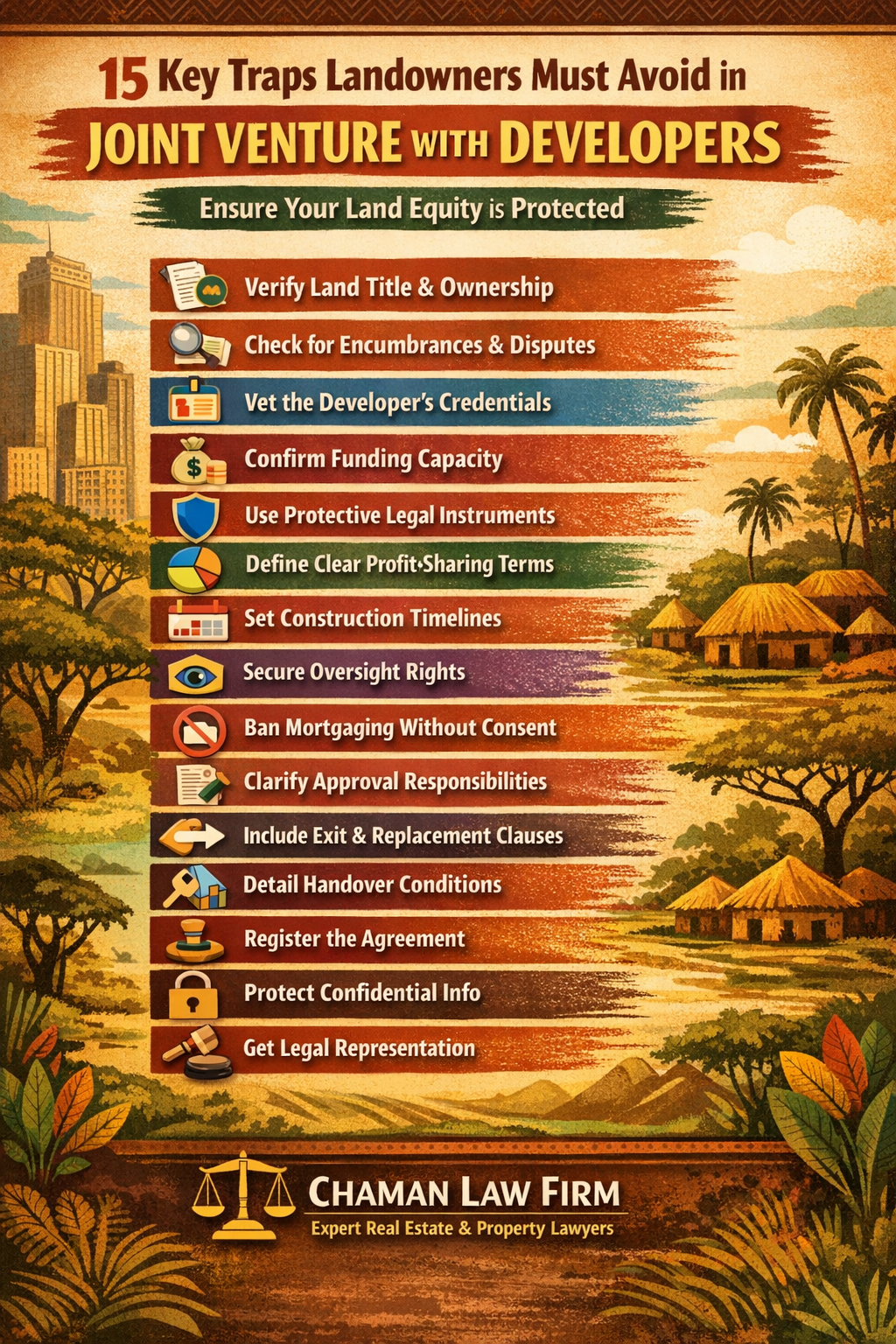
Land ownership in Nigeria—especially in fast-growth corridors like Lagos and Ogun—is more than a status symbol. It is commercial leverage. Increasingly, landowners contribute their land as equity in Joint Venture (JV) agreements with real estate developers, allowing the developer to fund and construct projects while the landowner earns a share of the developed assets or revenue. While JV deals can unlock extraordinary value, they also contain hidden legal, commercial, and structural risks capable of stripping landowners of their most valuable asset.
This article sets out a detailed, practical, legally sound, and commercially informed guide to help landowners negotiate from strength, protect their interests, and avoid fatal mistakes before committing land equity to any development partner.
1. Confirm That Your Land Has Legally Tradable Title
The foundation of every land JV is valid and marketable title. Before negotiations even begin, the landowner must confirm the status of ownership documents, which may include:
Certificate of Occupancy (C of O) Registered Deed of Assignment Excision or Gazette (for lands originally under acquisition) Approved Survey Plan (LSG/OGSG standard) Family or Community Head Consent (if applicable) Court Vesting Order or Letters of Administration/Probate (if inherited)
If your land has unresolved title defects, pending litigation, government acquisition issues, or unregistered documents, it weakens your negotiating power and exposes the land to challenge. Developers may later use these defects to renegotiate terms or blame the landowner for project failure.
2. Conduct a Full Boundary & Land Status Verification
A landowner must independently verify that the land is:
Not within government acquisition (or properly excised if previously acquired) Free from encumbrances, third-party claims, or overlapping surveys Physically matching the size and coordinates on the survey Not subject to community dispute or family contest
Relying on a developer’s due diligence is a strategic error. The landowner must commission their own verification with licensed surveyors and legal consultants.
3. Confirm the Developer’s Corporate Legitimacy
Landowners must verify that the developer is:
A registered entity with CAC (Company or Limited Partnership preferred) Financially stable and not operating a disposable “project-only” company Tax compliant Not subject to winding-up proceedings, debt judgments, or insolvency risk
A search at CAC should confirm shareholding structure, directors, address, filing status, and years of operation. Developers sometimes create a new SPV (Special Purpose Vehicle) to receive the land and develop. This is acceptable only if the landowner has:
A charge or stake in the SPV Director or shareholder rights Oversight and control mechanisms
4. Demand Evidence of Development Funding Capacity
The landowner contributes land. The developer contributes capital. The landowner must request:
Bank statements (not screenshots) Proof of access to project financing Existing portfolio of completed developments Investor or institutional backing, if claimed A clear development budget and timelines
Many developers oversell their capacity. Once land is committed, the landowner has little recourse if funding fails without contractual protections.
5. Avoid Transferring Title Until Protective Instruments Are Registered
Developers may request that title be transferred early to facilitate approvals. A landowner should never permanently transfer title unless:
The JV contract is signed, witnessed, stamped, and registered A caution or restriction is placed at the Land Registry A JV memorandum or registrable interest notice is lodged The developer cannot unilaterally mortgage or encumber the land
A better structure is to use:
Irrevocable Power of Attorney (PoA) limited strictly to development purposes Deed of Equity Contribution without full ownership transfer Caution at Registry blocking third-party dealings Tripartite escrow arrangements where documents are released in stages
6. Ensure Profit-Sharing Formula Is Clear, Realistic & Not Ambiguous
The sharing ratio must be written in precise terms such as:
“Landowner receives 40% of completed units” or “Landowner receives 30% of gross revenue after sale or lease”
Avoid vague formulations like “share shall be agreed after completion” or “equity shall be negotiated after approval.” These clauses are traps. Sharing must be defined before execution.
7. Insist on a Construction Timeline with Penalties for Delay
Time is value in real estate. The landowner must include clauses that:
Define project commencement date Set milestones (foundation, decking, roofing, finishing, handover) Impose liquidated damages for delay Allow termination if commencement does not occur within a fixed period Prevent indefinite land tie-down
A clause example:
“Developer must commence construction within 90 days of obtaining approvals, failing which landowner may terminate and revoke PoA without compensation.”
8. Secure Project Oversight Rights
Even if the developer funds the project, the landowner must retain oversight through:
A seat on the Project Steering Committee Monthly construction progress reports Independent project audit rights Right to inspect the site with professionals Right to approve material changes to design or plan
Without oversight, the landowner is blind while equity is locked in the land.
9. Prevent the Developer from Mortgaging the Land Without Consent
Developers sometimes use JV land to secure loans. This is acceptable only if:
Landowner gives written, notarized consent Loan terms are disclosed Landowner signs as a party to the charge Landowner share is protected even in default Land cannot be sold by the bank without triggering developer replacement or project takeover
Never allow a clause that permits unilateral land financing.
10. Protect Against Regulatory, Planning & Approval Risk Transfer
Developers may try to shift approval risk to landowners. The contract must clarify that the developer is responsible for:
LASBCA approvals Building permits EIA (Environmental Impact Assessment), if required Planning fees Infrastructure compliance Community settlement costs, if any
Landowners should not bear approval cost unless it is proportionate and capped.
11. Include Termination & Developer Replacement Clauses
Land JV contracts must contain clear exit mechanisms, including:
Revocation of PoA upon termination Right to replace developer if project stalls No land forfeiture upon termination No compensation for developer if approvals were not secured Right for landowner to take over project or appoint a new partner
12. Define Handover Terms & Landowner Benefits Clearly
If sharing is by units, the landowner must ensure:
Which exact units belong to them (floor, facing, size, parking, title docs) That they receive their units finished to habitable standard That title documents for their units will be processed at developer’s cost
If sharing is by revenue, define:
Payment schedules Audit rights Sales transparency Bank account disclosure Currency of payment
13. Ensure the Agreement Is Registrable & Enforceable
The JV agreement should be drafted in a registrable format capable of being lodged at:
State Land Registry Court (if enforcement becomes necessary) Investor or institutional partners (if needed)
A non-registrable agreement is a weak agreement.
14. Protect Trade Secrets, Designs & Project Information
Developers sometimes copy landowners’ land banks or project strategies. The agreement should contain:
Confidentiality clauses Non-circumvention clauses Non-solicitation clauses IP ownership clarification if the landowner contributed concept or design
15. Use Proper Witnessing, Stamping & Legal Representation
Every landowner must ensure:
Independent legal counsel reviews the contract Agreement is stamped All parties sign physical copies BVN or identity verification is attached if necessary Landowner spouse consent is added if required Guarantor clauses exist if developer is an SPV entity
Conclusion
A Joint Venture agreement is not merely a partnership—it is a temporary exchange of power. The developer receives access to land value. The landowner must receive access to capital value. Only a contract drafted with clarity, protections, enforcement rights, and oversight balances ensures that this exchange remains fair and profitable.
Call to Action
If you are a landowner in Lagos, Ogun, or any high-growth region in Nigeria and wish to contribute your land for development under a properly structured, legally protected, and commercially sound Joint Venture Agreement, do not enter negotiations alone.
Chaman Law Firm specializes in protecting land equity in real estate development, structuring safe escrow instruments, blocking unilateral developer control, and drafting watertight JV agreements that secure your land value and guarantee your profit.
Work with us today.
Your land is your leverage—we ensure it remains your victory, not your risk.