

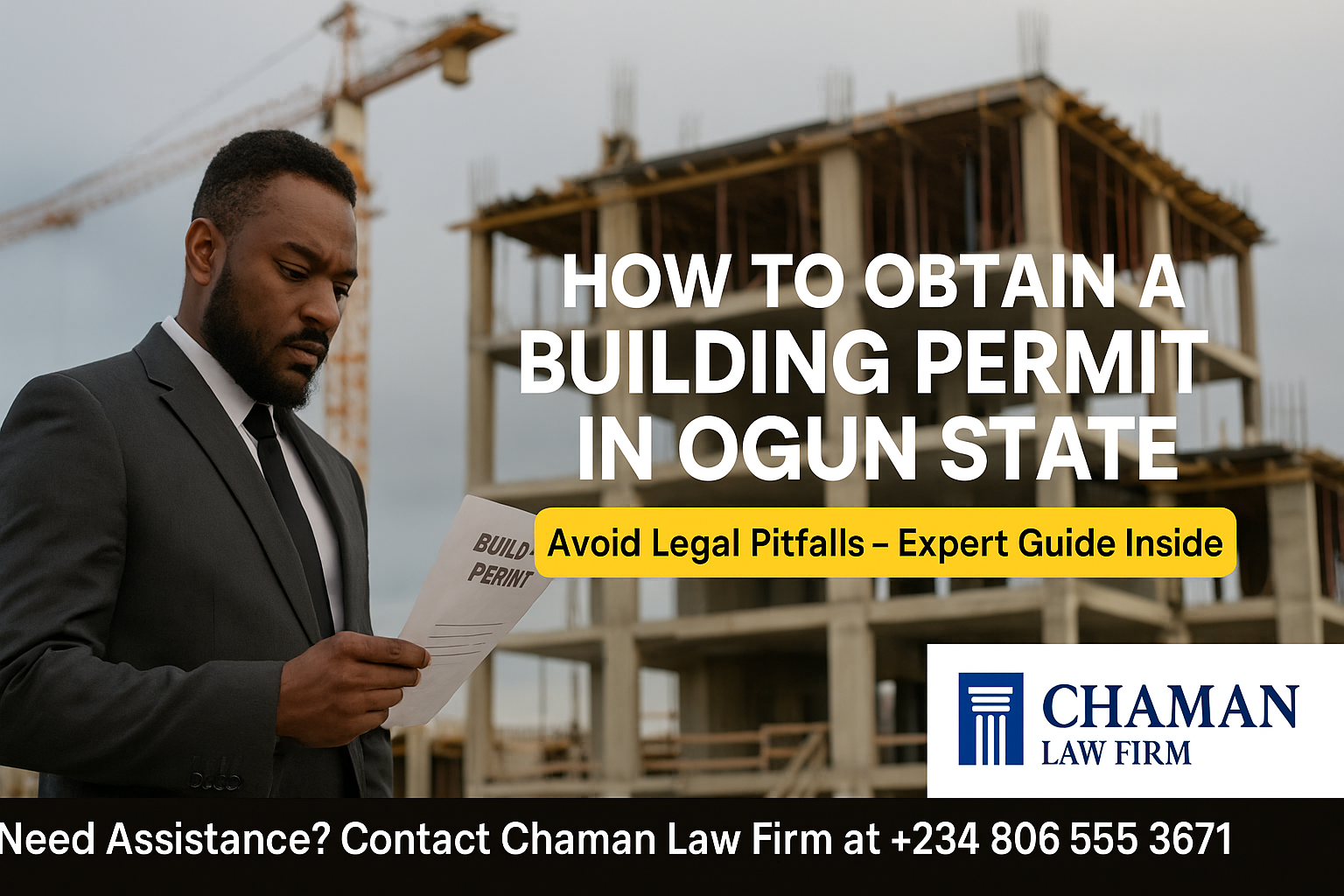
What Are the Required Permits for Estate Development in Ogun State?
Introduction
Establishing a residential or commercial estate—plots, roads, utilities, gates, amenities—in Ogun State is a rewarding investment. But it is also subject to legal, technical, environmental, and regulatory requirements. Cutting corners or omitting any required permit can lead to serious consequences: stalled projects, demolition, legal disputes, loss of money, reputational damage.
This article explains everything you need to know about the permits required for estate development in Ogun State—what each permit involves, when to apply, what documents are needed, the authorities involved, and how to ensure compliance. At the end is a call to action: steps you should take now to get your estate development properly permitted.
Legal & Regulatory Context
Before digging into specific permits, it’s important to understand the overarching laws and body/bodies responsible:
Ogun State Urban and Regional Planning Law (2005): This law provides the basis for physical planning, layout regulation, development permit authority, and enforcement.
Ogun State Planning & Development Permit Authority (OGPDPA): The agency that issues planning permits, enforces compliance, monitors developments, approves layout and building plans.
Ministry of Physical Planning and Urban Development: Oversees planning policy, master/zoning plans, coordinates with OGPDPA and other relevant departments.
Ogun State Layout & Land Subdivision Regulation (2022/2020): Requires that layout/designs for new estates or land subdivisions be approved; regulates size (hectares), setbacks, roads, drainage, utility corridors, etc. wfm917.com+2Punch News+2
Other relevant laws: These include environmental, drainage, public health, utilities, land rights, title laws, etc. Non‑compliance in any area can delay or block approvals.
Key Permits / Approvals Required for Estate Development
Below is a breakdown of the main permits, approvals, and documents almost always required when developing an estate in Ogun State.
| Permit / Approval | Purpose / What It Authorizes | When Needed | Authority / Department | Key Documents / Requirements |
|---|---|---|---|---|
| Title/Ownership Documents | To prove legal ownership or right to develop the land. Without a clear title, you cannot get most other permits. | Very early stage—before you start design or subdividing land. | Bureau of Lands & Survey or State Lands Department / Ministry of Physical Planning & Urban Development | Certificate of Occupancy or its equivalent, deeds, assignments; verification that land is not under government acquisition; checking that land is not in a restricted zone. Punch News+2DAILY TIMES Nigeria+2 |
| Layout Plan Approval / Subdivision Permit | To design how the estate will be laid out: roads, plot sizes, drainage, open space, utility allocation etc. It ensures conformity to planning laws, zoning, road reserve, setbacks etc. | Before subdividing land, before selling plots, before constructing major estate infrastructure. If land is more than 1 hectare, layout permit is mandatory. wfm917.com+1 | OGPDPA, Ministry of Physical Planning & Urban Development, Bureau of Lands & Survey. | Survey plan; architectural/engineering layout drawings; map showing roads, drainage, open spaces; compliance with road reserve, drainage, zoning; proof of ownership/title; land use or environmental impact (if required); fees. Punch News+2DAILY TIMES Nigeria+2 |
| Planning Permit (Permit in Principle / Development Permit) | Authorizes that your proposed development is consistent with planning laws/regulations. Confirms technical feasibility, initial approval to proceed with detailed designs. | Early in project lifecycle, usually after layout plan but before full building/construction detailed plans. | OGPDPA / Ministry of Physical Planning & Urban Development. Ogun has a “Permit‑in‑Principle” process. mppud.ogunstate.gov.ng+2ogtv.com.ng+2 | Project brief; site location plan; survey plan; title documents; preliminary designs; sometimes environmental data, utilities plan; payment of application and processing fees. mppud.ogunstate.gov.ng+1 |
| Planning Information | A document or clearance that provides specific information about the land: zoning status, constraints, whether the proposed use is permitted, setbacks, airspace, etc. | Often sought before detailed design or to inform the Permit in Principle and layout. Helps in identifying constraints so design can accommodate them. | OGPDPA, physical planning department. | Site location plan; survey plan; possibly satellite imagery; project brief. mppud.ogunstate.gov.ng |
| Building Plan Approval | Approval for detailed design and construction of infrastructure: roads, drainage, houses/buildings, amenities, utilities. Ensures that building designs comply with safety, set‑backs, structural, fire safety, zoning, etc. | Before constructing any buildings or infrastructure in the estate. | OGPDPA; Ministry of Physical Planning & Urban Development; local town planning / building control departments. | Detailed architectural drawings, engineering/structural plans, site plan showing buildings relative to roads, setbacks, drainage; ownership documents; building materials specification; sometimes environmental clearance; proof of compliance with any required codes. |
| Environmental / Drainage / Health Permits / NOCs | To ensure that the development does not violate environmental laws, that drainage and flooding are properly handled, and public health is protected. Also, services (water, sanitation, utilities) require clearances. | Before construction of roads, housing/structures, or any earthworks; when proposed site has environmental risk (floodplain, wetland), or when environmental impact is likely. | State environmental protection agencies; local government health departments; drainage & flood control authorities; utility providers. | Environmental impact assessment (if required); drainage plan; water supply plan; waste disposal plan; soil tests; public health plan; sometimes consent/NOC from utility providers (electricity, water, gas). |
| Survey Plan / Boundary Plan | To mark exact boundaries, to ensure plots are correctly demarcated, avoid encroachment, define roads, plot corners etc. These are legal documents. | Before layout approval; needed when subdividing plots; before construction of infrastructure. | Registered/licensed Surveyors; Surveyor General’s Office; Bureau of Lands. | Survey drawings; plan signed by registered surveyor; possibly verification that boundaries conform; sometimes verification by state survey office. |
| Approval for Roads / Access / Infrastructure | To build roads, internal drainage, sidewalks, street lighting, gates, security, etc., within estate. Ensures compliance with road standards and integration with State/local infrastructure. | Before constructing roads etc., often part of layout or detailed engineering plan stage. | Local government roads department; physical planning; OGPDPA; sometimes Ministry of Works or equivalent. | Engineering design of roads, drainage, cross‑sections, road reserve width, materials proposed; access to major roads; alignment; utility corridors; approvals from utility companies. |
| Utilities / Services NOCs | To ensure availability and compliance of services: electricity, water, sewage/septic or sewer connections, telephone / telecom, possibly gas. Some utility providers need to give no‑objection or consent before building. | Before implementing utility lines or connections, or before building structures that require utility service. | Utility providers; state ministry in charge of infrastructure; local government as applicable. | Utility layout plan; proof that provider can supply service; sometimes service agreement; technical designs. |
| Advertisement / Land Sale Permit | If the developer intends to market and sell plots, advertise, or display estate lots for sale, there are rules: advertising land without layout approval or required permits is illegal; regulatory oversight of advertisements. | Before marketing, selling plots, displaying on media, banners, etc. | Ministry of Physical Planning & OGPDPA; local government; possibly agencies in charge of consumer protection. | Approved layout plan; proof of permits (layout, planning, title); advertisement content compliance; NOCs maybe; payment of advertisement permit fee. wfm917.com+1 |
Additional / Optional / Situational Permits
Depending on the location, size, environment, or special features, there may be additional permits or clearances:
Environmental Impact Assessment (EIA): If the estate is large, in environmentally sensitive area, near waterways, wetlands, forest reserves.
Flood Risk / Drainage Clearance: If the site is prone to flooding or affects water courses.
Heritage / Culture or Protection Permits: If site contains or is near heritage sites.
Utilities Specific Permits: Gas lines, telecom, internet providers, etc.
Occupancy Permit or Certificate of Completion: At the end, when houses / buildings are complete and ready for habitation or sale. Ensures all works are done per approved plan, safe for use.
Insurance for Large Buildings: If there are common infrastructure (gates, high retaining walls, etc.) or buildings above a certain size, height or storeys.
Process / Sequence of Getting Permits
Here’s a typical sequence estate developers follow to obtain all required permits and approvals. This can vary somewhat depending on particular local government area, zoning, size etc.
Secure ownership / verify title deed / proof of land rights.
Conduct survey of the land; prepare a survey plan.
Determine zoning status, check land use designation; check if land is under government acquisition or restriction.
Prepare a layout plan (road network, plot layout, drainage, open spaces, amenities).
Submit layout plan to OGPDPA / Ministry of Physical Planning for layout approval or subdivision permit.
Apply for Permit‑in‑Principle / Planning Permit, to get pre‑approval on proposed development.
Obtain planning information / site information to understand constraints (setbacks, airspace, flood risk, etc.).
Prepare detailed engineering/designs for roads, drainage, infrastructure.
Apply building plan approvals for estate infrastructure and individual houses / buildings.
Secure environmental or health or utility provider NOCs as needed.
If marketing or selling plots, ensure advertisement / land sale permits are in place, and that layout is approved.
After construction, obtain occupancy certificates / completion certificates; ensure all works are up to approved standard.
Common Mistakes / Pitfalls in Permit Process
Here are some things developers often miss or do wrong, which cause delays, rejections, or legal/financial trouble:
Advertising or selling plots before layout plan approval. This is illegal and can lead to sanctions. ogunradio.ng+1
Neglecting verification whether land is under acquisition or government reserved. Buying or developing on land that is under “government acquisition” can nullify plans. Punch News+1
Incomplete documentation (survey, title, sketches). Missing any required document often delays the process.
Deviation from approved plans (roads, setbacks, plot sizes). Once layout is approved, you must stick to it. Changes often require fresh approvals or amendments.
Ignoring environmental and drainage requirements. Poor drainage planning leads to flooding, complaints, possible revocation.
Underestimating the time, effort, and cost of obtaining all NOCs and permits. Not building this into budgets and timelines.
Not engaging professionals: surveyors, architects, engineers, town planners. Trying to do it all oneself often leads to errors.
Benefits of Having Proper Permits
Why go through all this effort? Because:
Your development becomes legally recognized; future buyers will trust it.
You reduce risk of demolition, seizure, sealing, or legal action.
Infrastructure gets built properly; better access, drainage, street layout etc., adding value to estate.
Promotes safety: for residents, buildings meet structural and fire safety, public health requirements.
Easier to market plots / houses; buyers are more confident if permits are in place.
Helps avoid conflicts with government or neighboring developments.
Enforcement & Sanctions if Permits Are Missing
What happens if developers fail to get required permits / violate layout regulations?
Government may issue stop‑work orders, sealing of portions of estate.
Projects may be declared illegal, and subject to demolition or restrictions.
Developers or estate promoters may be fined or penalized.
Engagements (advertisement / sale) may be cancelled or invalidated.
In some enforcement drives, owners are required to submit title, layout, building plan documents or face sanctions. Nigeria News Today+2Punch News+2
If land is advertised without layout approval or title confirmation, media agencies, ad platforms may be penalized. wfm917.com
Practical Checklist: Permits & Documents for Estate Developers in Ogun
Use this checklist to make sure you have or are working on all the required components:
Valid title deed / certificate of occupancy (or legal proof of ownership)
Verification that land is not under government acquisition or reserved land
Survey plan showing boundary and topography
Layout / subdivision plan approval for the estate
Permit‑in‑Principle / Development Permit from OGPDPA
Planning Information / clearance about zoning, setbacks, flood risks etc.
Building plan approvals for roads, drainage, infrastructure, and housing units
Environmental / drainage / health NOCs where necessary
Utility provider approvals / agreements
Advertisement / land sale / marketing permit for plots (if you will market or sell)
Fees paid, including application fees, processing fees, any penal fees (if regularizing)
Completed works inspected; occupancy or completion permit obtained
Call to Action
If you are planning or already developing an estate in Ogun State, don’t leave things to chance. Here’s what you should do right now:
Carry out a full audit of where you are in the process: which permits you have, which you don’t. Use the checklist above.
Engage professionals (surveyor, town planner, architect) to help you draw up correct layout plans and building designs that meet regulations.
Submit your layout plan and permit‑in‑principle before doing any major infrastructure construction or selling plots.
Obtain all NOCs needed (environmental, health, drainage, utilities) before starting construction.
Ensure any advertising or marketing of plots is based on approved layouts and valid permits.
Stay in touch with OGPDPA / Ministry of Physical Planning — check whether there are grace periods or incentives (e.g. penal fee reductions), and keep updated with any regulatory changes.
Conclusion
Developing an estate in Ogun State is not only about acquiring land and building houses or plots; it is about navigating a web of permits and approvals—from title verification, layout approval, building plans, infrastructure works, environmental clearances, to advertising permits. Proper compliance not only keeps your development legal and safe but enhances value, trust, and long‑term viability.
Adhering to these required permits ensures that your estate development is sustainable, respected, safe and likely to succeed. Do not start construction, roads, plot sales or marketing without having obtained the necessary permits. It is far less costly in time, money, and reputation to do things right from the start.
Contact Us
Chaman Law Firm
115, Obafemi Awolowo Way,Allen Junction, Beside Lagos Airport Hotel, Ikeja, Lagos
📞 0806 555 3671, 08096888818,
